
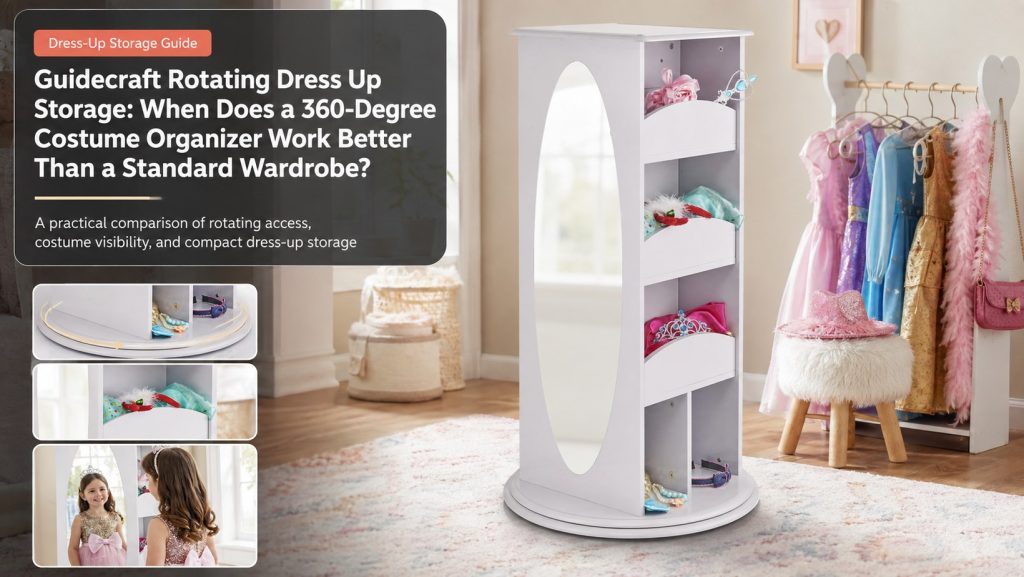
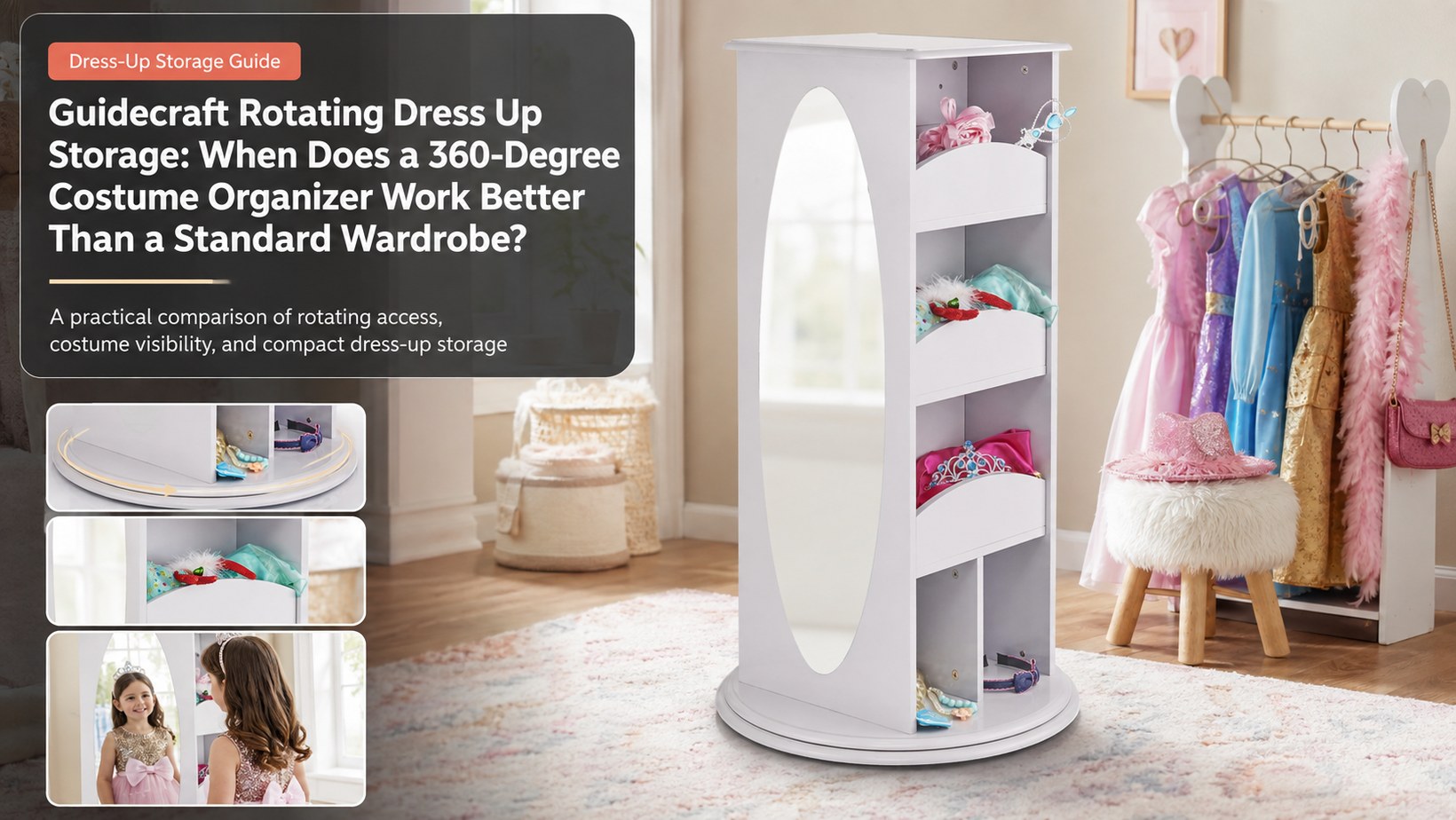
Guidecraft Rotating Dress Up Storage is worth evaluating in the context of the whole room, not as a standalone product. A rotating costume center trades wall efficiency for access. It can reveal several storage faces without doors, but the room needs enough clearance for the unit to turn and for children to move around it without catching costumes on nearby furniture.
This guide is written for parents creating an interactive dress-up corner for children who change outfits often and benefit from access on more than one side. The aim is to compare fit, daily use, organization, assembly, maintenance, and safety before purchase so the furniture solves a repeatable household need rather than adding another object to manage.
How To Evaluate Guidecraft Rotating Dress Up Storage In A Real Room
Guidecraft’s current product information describes an engineered-wood rotating dress-up center with storage compartments, hooks, two full-length Mylar mirrors, and a child-focused height. The manufacturer lists an age recommendation of 3+ and dimensions around 23.5 by 23.5 by 42 inches, so the true use footprint is larger than the base once rotation and standing space are included.
For Guidecraft Rotating Dress Up Storage, the most useful comparison is between the furniture’s stated features and the exact behavior expected in the home. Measure the product location, the clearance needed while it is being used, and the path children and caregivers take around it. A dimension that looks compact on a product page can feel very different once doors, chairs, drawers, costumes, bins, or bedding move into their full-use position.
Before ordering, check the current product page for dimensions, materials, included components, age guidance, assembly requirements, maintenance instructions, and any load or mattress limits that apply. Product listings can change over time, so a buying decision should use the current model information rather than a remembered specification.
Choose Rotation Only When Multi-Sided Access Adds Value
Rotation Needs A Clear Circle, Not Just A Square Footprint
Measure the base and then add hand clearance, costume overhang, and space for a child standing at the mirror. A rotating unit placed too close to a wall loses the feature that makes it different from a fixed wardrobe.
Mirrors And Hooks Can Create Activity Stations
One side can support outfit selection while another holds accessories or mirror play. That division can help two children use the unit without immediately reaching into the same compartment.
Open Storage Benefits From Editing
Rotation exposes more items, but visual overload can make cleanup harder. Keep only the current favourites on the unit and store overflow costumes elsewhere for periodic rotation.
Balance Capacity, Child Access, And Room Safety
Use related products and categories as comparison points rather than as a checklist of items to buy. Each link below answers a different planning question, so parents can compare only the furniture types that match the child’s actual routine.
A rotating costume storage center should be checked for the exact current dimensions, mirror material, compartments, and assembly parts in the site listing.
A 360 degree kids wardrobe can be compared with fixed mirror-and-shelf furniture to decide whether rotation is actually useful in the available floor area.
For a dress up station with mirrors, compare one-sided wall placement with multi-sided access and the standing space each requires.
A revolving playroom organizer should be evaluated as part of the whole playroom layout because circulation space around the unit is part of its functional footprint.
A costume rack with trays and hooks offers a fixed alternative when accessory separation matters more than 360-degree access.
For space efficient pretend play storage, compare a shallow wall-based armoire with the rotating footprint before assuming the turntable design saves more room.
Rotating Center Vs Fixed Wardrobe
This comparison turns product features into room-planning questions. Use the final manufacturer specifications for the exact model when a measurement, load, mattress, age, or assembly detail affects the decision.
| Feature or Use | Potential Benefit | Planning Check |
|---|---|---|
| Access | Multiple faces can be reached | Fixed unit favors front access |
| Room placement | Works best with clearance around it | Can sit closer to a wall |
| Mirrors | Can create more than one play position | Usually one mirror position |
| Capacity visibility | More items visible while rotating | Some items may stay behind doors |
| Cleanup | Open zones can be intuitive | Enclosed storage hides visual clutter |
| Floor planning | Base plus rotation circle | Mostly cabinet footprint plus door clearance |
Anchoring And Tip-Over Risk
Do not let children spin the unit rapidly, ride on the base, or hang from hooks and shelves. Keep fingers clear of moving joints and make sure loose costume fabric cannot wrap around or jam the rotating base.
Guidecraft publishes the current specifications and care information for the Guidecraft Rotating Dress Up Storage. Review the manufacturer page with the exact retailer listing before purchase.
Before The Furniture Goes Into Daily Use
- Measure a full rotation circle on the floor
- Leave room for a child to stand at each mirror
- Check that costumes do not drag into the base
- Assign hooks and trays by accessory type
- Keep heavy props off upper areas
- Rotate the unit only as intended
- Inspect the rotating mechanism for obstruction
- Follow the manufacturer assembly instructions exactly
After assembly, observe the furniture during the first several days of normal use. Check for rocking, shifting, loosening fasteners, drawers or wheels that behave differently under load, and any new reach or climbing opportunity the furniture creates. Reassess the setup as the child grows because a room that is appropriate today may need different controls later.
Choose Storage Zones That Can Grow With The Child
Guidecraft Rotating Dress Up Storage makes sense when a room has enough clearance to use every side and the child benefits from visible costumes, mirrors, hooks, and trays in one activity center. In a narrow room, a fixed wall wardrobe may use the footprint more efficiently, so measure the rotation circle before deciding.
The final decision on Guidecraft Rotating Dress Up Storage should come from measured room fit, current product specifications, the child’s ability, and a realistic daily routine. A feature is valuable only when the family can use it consistently without creating avoidable clutter, awkward access, or new safety problems.
Frequently Asked Questions
How much floor space does a rotating dress-up organizer need?
More than the base dimensions alone. Allow for rotation, hanging costumes, the child’s standing position, and nearby walking paths.
Is the Guidecraft rotating unit intended for toddlers?
Guidecraft lists a manufacturer age recommendation for the product; verify the current page and supervise use based on the child’s ability.
Can two children use a rotating dress-up station at once?
Potentially, if the room has clearance and each child has a separate access side. Adult supervision is still important around moving furniture.
Should the organizer be placed against a wall?
Not if doing so prevents the unit from rotating as intended. Follow the manufacturer placement and assembly guidance.
How should costumes be organized on a rotating center?
Use broad categories such as long costumes, short costumes, hats, shoes, and accessories, and rotate overflow items rather than overloading the unit.
