
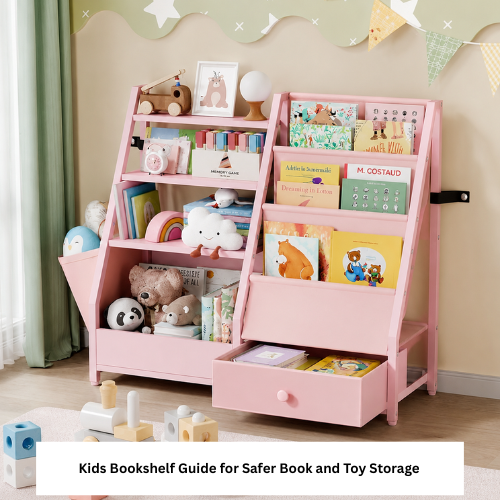
A stable kids bookshelf should keep books and lightweight toys accessible without encouraging climbing, overloading, or unsafe reaching. The best design depends on the child’s age, book sizes, room dimensions, shelf height, anchoring requirements, and whether the unit will also hold bins or display toys.
A toddler may benefit from a low front-facing book rack, while an older child may need deeper shelves for chapter books, school materials, games, and collections.
Kids furniture hub shoppers should compare usable shelf dimensions, base stability, wall hardware, edge quality, assembly requirements, warranty, replacement parts, and return restrictions.
How to Choose a Kids Bookshelf Safely
Start by measuring the room, the books, and the child’s comfortable reach.
Check:
- Available wall width
- Floor depth
- Baseboard clearance
- Door movement
- Window access
- Electrical outlets
- Walking paths
- Shelf height
- Shelf depth
- Largest book size
- Bin dimensions
- Wall-anchoring points
A narrow unit can save floor space but may be easier to tip if it is not secured correctly.
A kids bookcase storage guide can help parents compare shelf layouts, room placement, and storage capacity.
| Shelf style | Best suited to | Main advantage | Possible limitation | What to verify |
| Front-facing sling shelf | Toddlers and picture books | Covers remain visible | Holds fewer books | Sling strength and frame stability |
| Low open bookcase | Young children | Easy independent access | Children may climb the shelves | Anchoring and shelf spacing |
| Cubby bookshelf | Books plus bins | Separates categories | Bins reduce visible book space | Cubby dimensions |
| Tall bookcase | Older children and large collections | Uses vertical space | Greater tip-over concern | Wall anchoring |
| Book caddy | Small collections and reading corners | Portable and compact | Limited capacity | Handle and base design |
Measure Books and Toys
Books vary in height, width, and depth.
Measure examples from the collection:
- Board books
- Picture books
- Activity books
- School workbooks
- Chapter books
- Reference books
- Oversized books
Shelf depth should support the books without leaving large edges exposed into the room.
When adding toys, check:
- Toy height
- Bin dimensions
- Weight
- Shape
- Whether pieces can roll
- Whether the toy blocks book access
Do not place heavy toys or objects on top of a tall bookcase.
Low Shelves for Toddlers
A low sling bookcase may help toddlers see book covers and select reading material independently.
Low storage should still be:
- Stable
- Properly assembled
- Free of sharp edges
- Positioned away from stairs
- Kept clear of cords
- Anchored when required
- Loaded with suitable books
Front-facing storage can reduce the need to pull books from a tightly packed row.
Do not allow children to sit or stand inside fabric slings.
Book and Toy Combination Units
A book and toy organizer can combine upper book display with lower cubbies or bins.
This style may suit a playroom where parents want one unit for:
- Books
- Blocks
- Figures
- Art supplies
- Puzzles
- Stuffed animals
- Educational materials
Keep heavy bins in the lowest sections.
Do not overload shelves with containers that extend beyond the front edge.
Book Caddies and Portable Shelves
A book caddy with shelf may work in a bedroom corner, nursery, or supervised reading area.
Check:
- Handle design
- Total weight
- Base width
- Shelf depth
- Carrying guidance
- Rounded edges
- Hardware
- Floor protection
A loaded caddy may be too heavy for a child to move safely. Treat portability claims cautiously and verify before buying.
Practical Bookshelf Buying Checklist
- Measure the wall, floor depth, and baseboard.
- Measure the largest books.
- Decide between spine-out and front-facing storage.
- Check child-reachable shelf height.
- Compare shelf depth and spacing.
- Confirm bin and toy compatibility.
- Review base stability.
- Check wall-anchoring instructions.
- Store heavy items low.
- Keep cords and climbing furniture away.
- Inspect materials and edges.
- Follow assembly instructions.
- Confirm replacement shelves and bins.
- Review cleaning requirements.
- Verify the kids bookshelf remains stable when loaded.
- Check warranty terms.
- Read return restrictions for assembled furniture.
- Inspect delivery damage promptly.
- Verify before buying all dimensions, materials, load limits, certifications, and safety claims.
Conclusion
The right kids bookshelf should place everyday books within easy reach while remaining stable, properly anchored, and suitable for the room. Measure books and available space, keep heavy items low, inspect edges and materials, and review assembly, cleaning, warranty, replacement-part, and return information before purchasing.
FAQ
What height is best for a toddler bookshelf?
A low unit that allows comfortable access without climbing is often practical, but stability and anchoring still matter.
Should a children’s bookcase be anchored?
Follow the manufacturer’s instructions. Tall, narrow, or climbable units generally require anti-tip anchoring.
Are front-facing shelves better?
They make covers easier to see and can help young children choose books, although they usually hold fewer items.
Can a bookshelf also store toys?
Yes, when shelf dimensions, bins, weight limits, and stability are suitable.
Where should heavy books be stored?
Place heavier books on lower shelves to improve access and weight distribution.
