
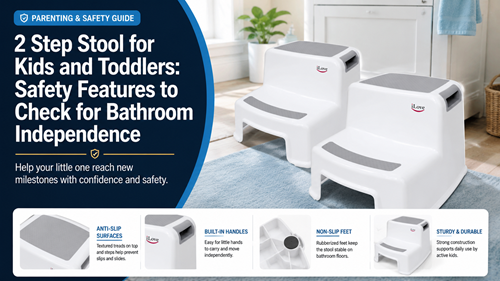
2 Step Stool for Kids and Toddlers deserves to be judged by the way it fits the room and the family routine, not by the product name alone. A two-step stool can help a toddler reach a sink, but added height also changes what the child can touch and how far a fall could be. Floor grip, tread size, step rise, weight guidance, placement, and adult supervision should be considered together.
This guide is for parents supporting bathroom independence during handwashing and potty-training routines. It focuses on anti-slip design, sink reach, load guidance, placement, cleaning, and the new hazards that become reachable once a stool is introduced.
2 Step Stool for Kids and Toddlers: Fit, Function, and Daily Use
The stored product record for the iLove two-step stool lists plastic construction, dimensions around 14 inches deep, 12.7 inches wide, and 10.5 inches high, with slip-resistant feet and soft-grip tread surfaces. The product record describes a dual-height design and a stated load capacity; verify current manufacturer limits and floor-use instructions.
For 2 Step Stool for Kids and Toddlers, room planning should include the furniture footprint plus the space needed to open, move, reach, sit, sort, or step around it during normal use. Parents often measure only the frame and then discover that bins, doors, stools, chairs, hanging clothes, or a child’s body need extra clearance.
A stool should solve one controlled reach problem at a time. Bathroom independence is safer when the child faces the sink, both feet fit on the tread, and an adult remains close enough to intervene immediately.
Six Buying Questions to Work Through
2 Step Stool for Kids and Toddlers Anti-slip Safety
Anti-slip materials are useful only when the floor itself is clean, level, and dry. 2 Step Stool for Kids and Toddlers anti-slip safety Check both the base feet and the standing surface instead of relying on one rubber strip.
2 Step Stool for Kids and Toddlers Sink Reach
Measure the child’s current reach rather than buying the tallest stool available. 2 Step Stool for Kids and Toddlers sink reach The goal is a comfortable handwashing position without unnecessary extra height.
2 Step Stool for Kids and Toddlers Potty Training Use
For toilet routines, make sure the stool does not block the caregiver, door, or safe approach to the toilet. 2 Step Stool for Kids and Toddlers potty training use Use it only for the tasks the child can manage with supervision.
2 Step Stool for Kids and Toddlers Weight Support
Published load guidance applies to the product in good condition on an appropriate surface. 2 Step Stool for Kids and Toddlers weight support Do not treat a high number as permission for jumping, rocking, or multiple users.
2 Step Stool for Kids and Toddlers Bathroom Placement
Choose a dry, flat position where the stool cannot slide into a tub, door swing, cabinet, or sharp corner. 2 Step Stool for Kids and Toddlers bathroom placement Store it so the child cannot use it to reach medicines or cleaners unsupervised.
2 Step Stool for Kids and Toddlers Cleaning Tips
Bathroom floors collect water, soap, toothpaste, and lotion. 2 Step Stool for Kids and Toddlers cleaning tips Clean both the tread and the underside feet regularly so traction surfaces can work as intended.
Bathroom Step Stool Safety Check
Use this table to compare 2 Step Stool for Kids and Toddlers with the demands of the room. The goal is not to score every feature equally; it is to identify which details change safety, access, cleanup, comfort, or long-term usefulness.
| Decision Point | What to Check | Why It Matters |
|---|---|---|
| Floor surface | Dry, level, non-slippery area | Base grip cannot compensate for standing water |
| Step size | Whole foot fits securely | Reduces edge-standing and missteps |
| Sink reach | Child can reach without leaning far | Limits balance loss |
| Placement | Clear of tub and door swing | Prevents collisions and falls |
| Storage | Away from medicines and cleaners | Stool changes what a child can reach |
Teach One Bathroom Routine At a Time
Start with a single task such as handwashing. Show the child where the stool belongs, how to face the sink, how to step up and down, and that the stool is not for jumping or moving around the room.
When the routine becomes consistent, reassess reach and supervision needs. A child who can stand independently on the stool may still need help controlling water temperature, soap, or objects stored near the sink.
Before the Furniture Goes Into Daily Use
- Dry the floor before use
- Place the stool square to the sink
- Check base feet and tread
- Keep both feet on the platform
- Supervise stepping up and down
- Lock away medicines and cleaners
- Clean traction surfaces regularly
- Stop use if any part cracks or loosens
As the child grows taller, the second step may become unnecessary. Stop using the stool when the child exceeds manufacturer guidance or when the added height creates more risk than benefit.
A Step Stool Changes the Childproofing Map
Once a toddler can reach a sink or counter, faucets, medicines, cleaning products, razors, cords, windows, and cabinets that were previously out of reach may become accessible. Childproofing must be reassessed wherever the stool can travel.
Review the CPSC childproofing guidance for the home and keep hazardous items locked away even when they use child-resistant packaging.
Never place the stool in a bathtub, shower, on another stool, on a soft mat that lets it rock, or on an uneven surface. Constant supervision is still required around water.
Use the Minimum Height Needed for the Task
A two-step stool can support independence when it gives the child a stable, predictable way to reach one task. The safest setup uses the lowest practical height, a dry floor, adequate tread area, clear surroundings, and close adult supervision.
The final decision on 2 Step Stool for Kids and Toddlers should come from measured room fit, current manufacturer information, the child’s age and abilities, and a routine the family can maintain. A feature is valuable only when it solves a real household problem without creating avoidable clutter or risk.
Frequently Asked Questions
Is a two-step stool safer than a one-step stool?
Not automatically. More height may improve reach but also increases fall distance. Choose the minimum height needed.
Can a toddler move the stool independently?
That depends on age, product design, and supervision. Do not allow unsupervised access to new hazards created by the stool.
Can a bathroom stool be used in the kitchen?
Only if the manufacturer permits it and the surface and task are safe. Kitchen access introduces hot and sharp hazards.
How often should the rubber feet be cleaned?
Clean them whenever soap, lotion, dust, or moisture reduces grip, and inspect them regularly for wear.
When should the stool be replaced?
Replace or stop using it if the frame cracks, traction peels, feet loosen, or any structural part is damaged.
