
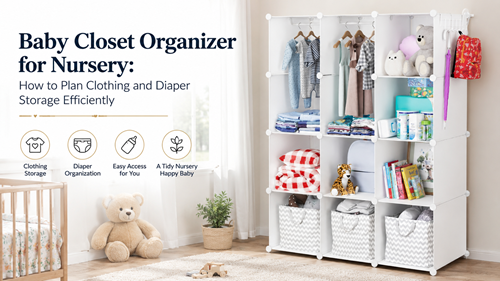
Baby Closet Organizer for Nursery deserves to be judged by the way it fits the room and the family routine, not by the product name alone. Nursery storage should help a caregiver find clothing and changing supplies quickly without placing unsafe items within a growing child’s reach. The best layout is usually based on frequency of use, garment size, backup stock, and future child access rather than the maximum number of compartments.
This guide is for new parents arranging baby clothes and daily-care supplies in a nursery closet. It focuses on capacity, space-saving layout, daily reset, child access, assembly, anchoring, and placement as the baby grows.
Baby Closet Organizer for Nursery: Fit, Function, and Daily Use
The stored CUBEDIY product record describes a modular baby closet organizer with metal and plastic components, 12 drawers, 12 shelves, hanging space, assembly instructions, and a wall fixation kit. It lists dimensions around 37.2 inches wide, 16.42 inches deep, and 48.94 inches high. Verify the current configuration and anchoring directions.
For Baby Closet Organizer for Nursery, room planning should include the furniture footprint plus the space needed to open, move, reach, sit, sort, or step around it during normal use. Parents often measure only the frame and then discover that bins, doors, stools, chairs, hanging clothes, or a child’s body need extra clearance.
At the beginning, adults control the entire organizer. Over time, lower drawers and shelves become reachable, so the layout should be designed to change as the baby begins crawling, pulling to stand, and exploring the room.
Six Buying Questions to Work Through
Baby Closet Organizer for Nursery Storage Capacity
Estimate how much current-size clothing, diapers, wipes, linens, and backup stock need to be active at one time. Baby Closet Organizer for Nursery storage capacity Do not use every compartment just because it exists.
Baby Closet Organizer for Nursery Space-saving Layout
A modular layout can use vertical space efficiently, but it still needs stable wall clearance and room to open drawers or access cubes. Baby Closet Organizer for Nursery space-saving layout Measure the complete use footprint.
Baby Closet Organizer for Nursery Daily Cleanup Routine
Create a short reset after laundry and diaper restocking so daily items return to the same zones. Baby Closet Organizer for Nursery daily cleanup routine Consistent placement is more valuable than perfect folding.
Baby Closet Organizer for Nursery Child-accessible Organization
As the child grows, move safe clothing and soft items to lower zones while medicines, creams, bags, cords, and choking hazards stay locked or out of reach. Baby Closet Organizer for Nursery child-accessible organization Plan the future layout early.
Baby Closet Organizer for Nursery Assembly Considerations
Build the organizer exactly as directed and install the wall fixation system before loading it. Baby Closet Organizer for Nursery assembly considerations Modular panels and connectors must be completely seated and periodically checked.
Baby Closet Organizer for Nursery Room Placement Ideas
Keep the organizer close enough to the changing routine to be useful but not where doors, drawers, or walkways are blocked. Baby Closet Organizer for Nursery room placement ideas Avoid creating a climbing path beside the crib or other furniture.
Nursery Storage Zone Planner
Use this table to compare Baby Closet Organizer for Nursery with the demands of the room. The goal is not to score every feature equally; it is to identify which details change safety, access, cleanup, comfort, or long-term usefulness.
| Decision Point | What to Check | Why It Matters |
|---|---|---|
| Daily diapers and wipes | Adult-reachable active zone | Fast access during changes |
| Current-size clothes | Grouped by type or outfit | Reduces searching |
| Next sizes | Higher backup zone | Keeps active drawers uncluttered |
| Linens | Dedicated shelf or cube | Bulky items stay separate |
| Unsafe supplies | Locked or inaccessible storage | Lower zones become reachable over time |
Organize By Frequency, Then By Size
Put the items used every day in the simplest locations. Backup diapers, next-size clothing, seasonal pieces, and extra linens can use higher or less accessible zones. This reduces the temptation to overfill the main drawers.
Review the organizer every few months. Babies outgrow clothing quickly, and the safety map changes as they start pulling, standing, and opening lower storage. A zone that was harmless for a newborn can become a climbing or access issue later.
Before the Furniture Goes Into Daily Use
- Inventory current-size clothing
- Separate daily and backup supplies
- Measure closet and drawer clearance
- Assemble every connector fully
- Install wall fixation as directed
- Keep heavy items low
- Lock medicines and unsafe supplies away
- Reorganize as the child gains mobility
Use labels that adults can maintain quickly. Detailed categories are unnecessary if the system slows laundry put-away or makes it difficult to notice when sizes need to be rotated.
Anchor Nursery Storage Before the Baby Becomes Mobile
Do not wait until a child starts climbing to install tip restraints. A modular closet can become interesting to pull on long before parents expect it, especially when handles, hanging clothes, or favorite items are visible.
Use CPSC’s Anchor It furniture safety resources together with the organizer’s wall-fixation instructions to reduce tip-over risk.
Keep plastic bags, creams, medicines, cords, small accessories, and other hazards out of reachable drawers. Periodically inspect connectors and wall hardware as the organizer is reconfigured.
Build a Nursery Closet That Can Change with the Child
The most efficient nursery organizer is one that saves adult time now and can be made safer as the child grows. Plan daily zones, backup zones, and inaccessible hazard storage separately, then anchor the system before it is loaded.
The final decision on Baby Closet Organizer for Nursery should come from measured room fit, current manufacturer information, the child’s age and abilities, and a routine the family can maintain. A feature is valuable only when it solves a real household problem without creating avoidable clutter or risk.
Frequently Asked Questions
How many clothing sizes should stay in the active organizer?
Keep the current size easy to reach and store future sizes separately so daily drawers stay simple.
Where should diaper creams and medicines go?
Keep medicines and other unsafe products locked or fully out of a child’s reach, even before the baby becomes mobile.
Does a modular organizer need anchoring?
Follow the manufacturer’s instructions. The stored product record specifically describes a wall fixation kit.
Should heavy items go on upper shelves?
Keep heavier items low when possible to improve stability and make adult access safer.
How often should nursery storage be reorganized?
Review it whenever clothing sizes change or the child gains a new mobility skill such as crawling, standing, or opening drawers.
