
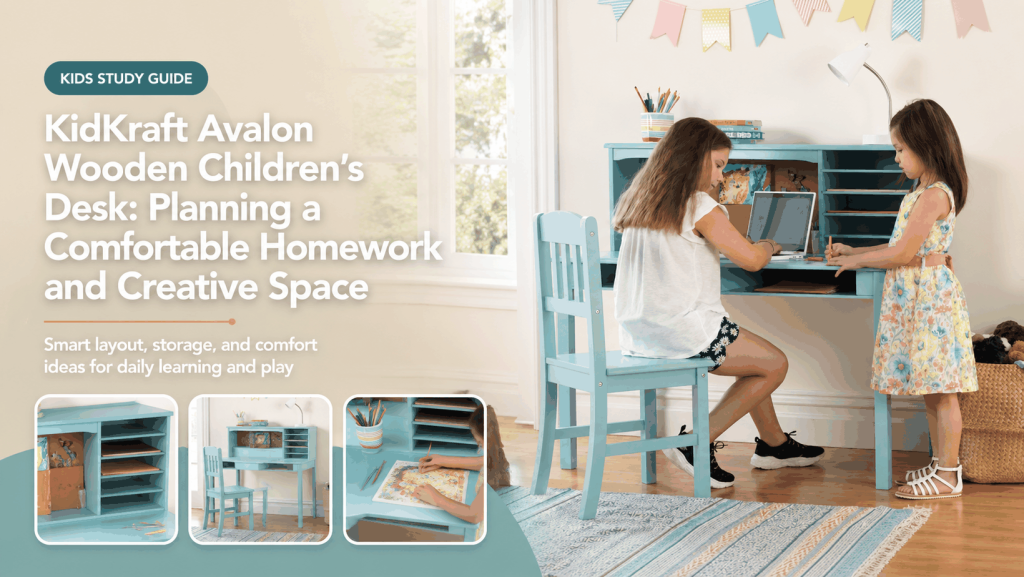
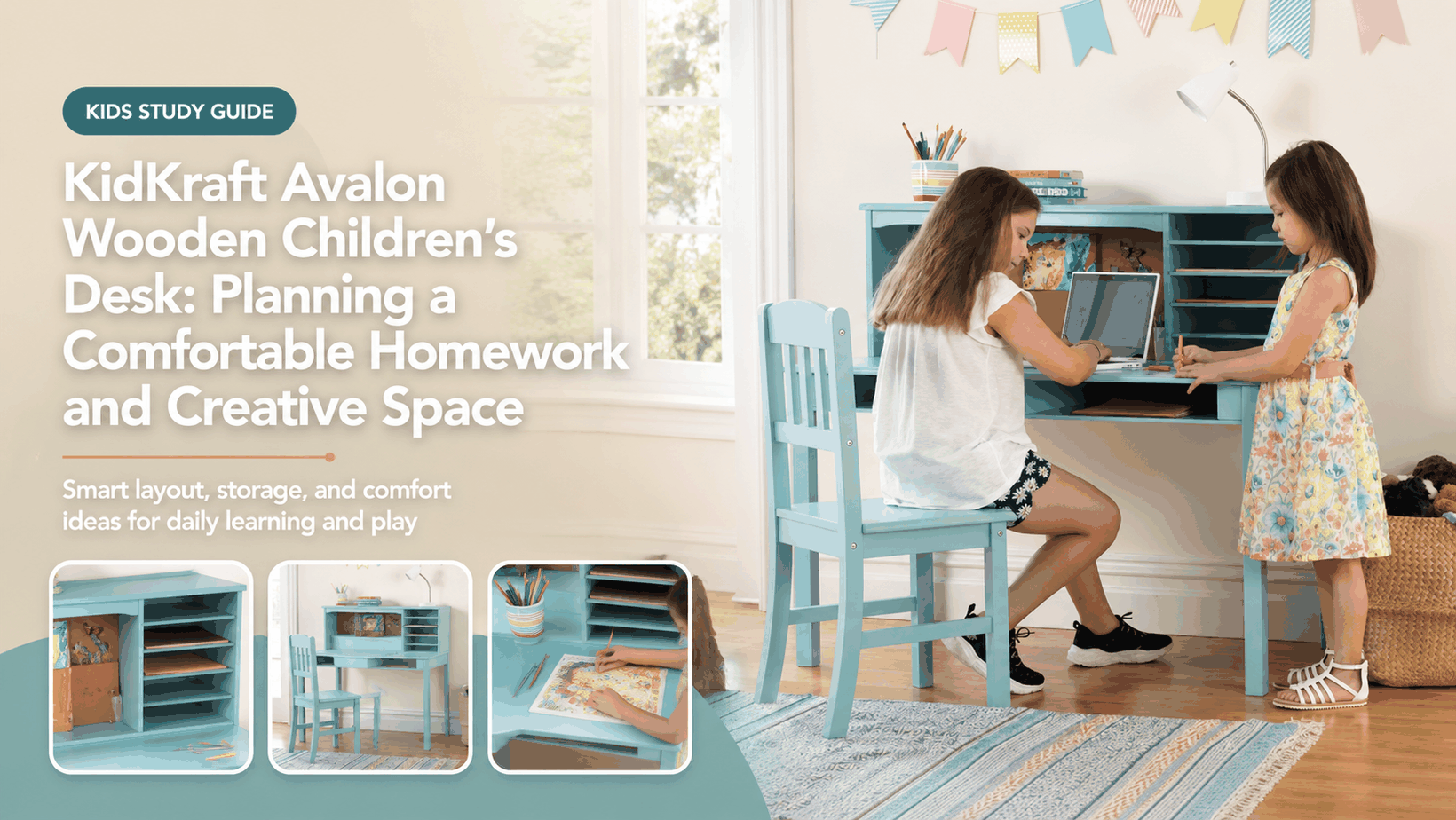
KidKraft Avalon Wooden Children’s Desk deserves to be judged by the way it fits the room and the family routine, not by the product name alone. A child’s desk should support homework, drawing, reading, and storage without becoming a place where papers and supplies pile up. Desktop area, chair fit, hutch access, drawer use, room placement, and assembly all affect how comfortable the station feels after the novelty wears off.
This guide is for parents setting up a dedicated learning and creative zone for children roughly ages five to ten. It focuses on desk storage, hutch organization, chair sizing, room fit, assembly planning, and a daily reset that keeps the workspace usable.
KidKraft Avalon Wooden Children’s Desk: Fit, Function, and Daily Use
The stored KidKraft Avalon product record describes a wooden desk with a hutch, chair, and one drawer. Product dimensions are listed around 23.6 inches deep, 32 inches wide, and 41.6 inches high. Verify the current set contents, chair dimensions, materials, and assembly instructions before ordering.
For KidKraft Avalon Wooden Children’s Desk, room planning should include the furniture footprint plus the space needed to open, move, reach, sit, sort, or step around it during normal use. Parents often measure only the frame and then discover that bins, doors, stools, chairs, hanging clothes, or a child’s body need extra clearance.
A child does not need a miniature office. The better goal is a clear work surface, comfortable seating, accessible supplies, and enough nearby storage to reset the area after homework or art.
Six Buying Questions to Work Through
KidKraft Avalon Wooden Children’s Desk Storage Setup
Start with the materials used every day and give them the easiest storage positions. KidKraft Avalon Wooden Children’s Desk storage setup Keep backup supplies out of the main drawer so the desk does not become a general household cabinet.
KidKraft Avalon Desk Hutch Organization
A hutch works best for light, frequently referenced items rather than heavy objects or decorative clutter. KidKraft Avalon desk hutch organization Leave the desktop visually calm so the child can focus on the current task.
KidKraft Avalon Desk Chair Sizing
Chair fit matters more than matching style. KidKraft Avalon desk chair sizing Compare seat height and depth with the child’s body and use a foot support if needed rather than encouraging dangling feet.
Kids Homework Desk Placement
Place the desk where lighting is useful and circulation remains clear. kids homework desk placement Avoid blocking a closet, door swing, heater, or narrow path beside the bed.
Children Study Desk Storage Ideas
Divide supplies by task instead of by color or brand. children study desk storage ideas A writing zone, art zone, and paper zone are easier for a child to maintain.
KidKraft Avalon Desk Assembly Planning
Plan assembly before the box is opened by clearing floor space and checking the hardware list. KidKraft Avalon desk assembly planning Complete every fastener, drawer adjustment, and stability step before the child begins using the desk.
Homework Desk Planning Table
Use this table to compare KidKraft Avalon Wooden Children’s Desk with the demands of the room. The goal is not to score every feature equally; it is to identify which details change safety, access, cleanup, comfort, or long-term usefulness.
| Decision Point | What to Check | Why It Matters |
|---|---|---|
| Desktop | Room for one active task | Reduces clutter and distraction |
| Chair | Feet and back can be supported | Comfort affects posture and focus |
| Hutch | Light accessible materials | Prevents overloading upper storage |
| Drawer | Current supplies only | Makes daily reset faster |
| Lighting | Daylight or well-placed lamp | Reduces shadows on reading and writing |
Create a Desk Reset That Takes Five Minutes
At the end of homework or drawing, clear the desktop completely except for one or two permanent items. Return pencils, paper, devices, and art materials to the same zones every day so setup time remains short.
Review the storage layout as school demands change. A child who begins with crayons and picture books may later need folders, chargers, notebooks, and reference materials, so the hutch and drawer should evolve without becoming overcrowded.
Before the Furniture Goes Into Daily Use
- Measure the desk and chair footprint
- Check chair fit for the child
- Choose the light source
- Keep heavy items low
- Reserve the hutch for light supplies
- Tighten all assembly hardware
- Anchor tall components if directed
- Create a daily desktop reset
If the desk becomes a drop zone for unrelated belongings, reduce what is stored there. A dedicated study surface is most useful when it can be made ready for work without a long cleanup first.
Keep Desks, Hutches, and Nearby Furniture Stable
Children may pull on a hutch, stand on a chair, or reach for objects above eye level. Follow the current assembly and anti-tip instructions and keep tempting heavy objects away from upper surfaces.
The CPSC Anchor It campaign explains why furniture tip-over prevention is important wherever children climb or pull on furniture.
Route lamp and device cords so they do not create loops or trip hazards, and keep outlets and power strips appropriate for the child’s age and room setup.
Build a Workstation That Can Reset Easily
A useful kids desk is not the one with the most storage. It is the one that supports a comfortable seat, a clear work surface, a few easy storage zones, and a room position that lets the child begin and finish tasks without fighting the furniture.
The final decision on KidKraft Avalon Wooden Children’s Desk should come from measured room fit, current manufacturer information, the child’s age and abilities, and a routine the family can maintain. A feature is valuable only when it solves a real household problem without creating avoidable clutter or risk.
Frequently Asked Questions
How much desktop space does a child need?
Enough for the main task plus necessary supplies. More surface is not useful if it becomes permanent storage.
Should the hutch hold heavy books?
Follow manufacturer load guidance. Heavy items are generally easier and safer to store lower.
What if the included chair is too tall?
Use an appropriate foot support or a better-fitting chair rather than encouraging the child to perch or dangle uncomfortably.
Where should a homework desk be placed?
Choose a well-lit area with clear circulation and no blocked door, closet, or heater.
How often should desk hardware be checked?
Inspect it after assembly and periodically during use, especially if the desk or chair begins to wobble.
